Photo: Wa LaB / After Vodundays
Discover · History · Ouidah, Benin
The Portuguese Fort of Docomè
Portugal held a piece of territory here until 1961, a year after Benin's independence. It took an ultimatum to dislodge it.
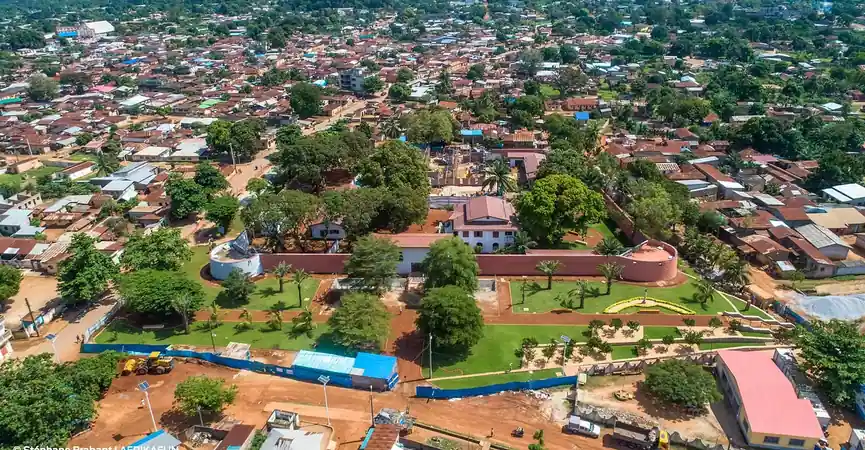
In the Docomè quarter, one of the oldest centres of settlement and power in Ouidah, stands the fort of São João Baptista de Ajudá, Ajudá being the Portuguese rendering of Gléxwé. Built in 1721, it did not merely live through the Atlantic slave trade: it remained a sovereign enclave of Portugal well into the twentieth century, in the middle of a territory that had become French, and then Beninese.
In 1721, the authorities of the Xwéda kingdom authorised the raising of a fortified enclosure at Docomè. Behind its walls and its cannon, the agents of the Portuguese crown stored the goods of exchange brought from Brazil and Europe, tobacco, weapons, alcohol, beads, and held captives before they were moved to the ships lying offshore.
In 1727, Agadja conquered Ouidah and brought the fort into the royal monopoly of Danxomè over the trade. A century later, the alliance between Ghézo and Francisco Félix de Souza made the site a pivot of the direct link between Ouidah and Salvador de Bahia. From the 1850s, as the legal trade came to an end, activity shifted towards palm oil without the Portuguese diplomatic presence ceasing.
The anomaly begins after 1894. France conquered Danxomè and established the colony of Dahomey, but the fort remained Portuguese territory. For more than sixty years, on one or two hectares, the flag of Portugal flew in the middle of a French colony, mail left bearing Portuguese stamps, and an administrator sent from Lisbon resided there.
Dahomey became independent on 1 August 1960. The Salazar government refused to hand back the fort. It took an ultimatum from President Hubert Maga to settle the matter: on 31 July 1961, before evacuating under duress, the last Portuguese administrator set fire to the archives and the main buildings, so as to leave nothing intact. The site was reintegrated into the national territory the following day.
Restored after the fire, the fort housed from 1967 the History Museum of Ouidah, which for more than fifty years displayed the objects of the trade, the regalia of the Danxomè monarchy and the ties woven between Ouidah, Brazil and the Caribbean.
The site is now living through its greatest transformation since 1961. The classical museum has closed. The governor's residence is being restored to become the Governors' Palace, and the complex is to house the International Museum of Memory and Slavery, with a route on deportation, the scenographic reconstruction of a slave ship hold, the archaeological remains uncovered at Docomè, and the royal and Vodun collections. We will update this page as the official schedule becomes clearer.
Visit duration
Exterior visit for the duration of the works
Access
Docomè quarter, Ouidah. The museum is closed to the public: the site is under renovation to become the Governors' Palace and the MIME. Check with us before planning this stop.
Coordinates
6.3591, 2.0902
Origin of this content · July 2026
Fiche established from the archives and documentation of the Directorate of Cultural Heritage of Benin, from the historiography of the Portuguese presence on the Gulf of Guinea, and from on-site monitoring by the After Vodundays team in Ouidah.
Sources and further reading
- Robin Law, Ouidah: The Social History of a West African Slaving 'Port', 1727-1892, James Currey, 2004.
- Directorate of Cultural Heritage of Benin, renovation dossier for the Docomè site.
You won't visit this place alone.
Our certified Vodun guides open the meaning behind every sacred site of Ouidah. What you will see, and what we will help you understand.