Discover · Memory · Diaspora
The Agouda of Ouidah,
those who came back.
Descendants of Africans deported to Brazil then returned free, the Agouda still live in Ouidah. Their history is the proof that return exists.
Ouidah · Bahia · Antilles · Brazil · Diaspora
A name that answers the question of the whole diaspora: can one return ? The Agouda answered it more than a century ago.
The community
Who are the Agouda?
The Agouda, sometimes spelled Aguda, are the Afro-Brazilian community of the Gulf of Benin coast, present in Ouidah, Porto-Novo and Cotonou, but also in Togo and Nigeria. The word refers to the descendants of Africans who, enslaved and deported to Brazil in the 18th and 19th centuries, regained their freedom and chose to return to the continent. To this first core were added freed people from Bahia and a few merchant families settled along the coast.
Being Agouda in Ouidah is not a folkloric detail. It is a full identity, with its surnames, its faith, its architecture and its table. You recognize it in names that became those of the great families of the town: de Souza, d'Almeida, Paraiso, de Medeiros, da Silva, dos Santos, Vieyra. Behind each one lies a path that crossed the Atlantic twice.
The History
The return, from Bahia to Ouidah
The story of the Agouda is one of return, and that is what makes it so rare. In the 19th century, after decades of deportation to Brazil, thousands of freed people took the opposite road. Many came from Bahia, where the Malê revolt of 1835 hardened the fate of free Africans and pushed many of them to sail back toward the land of their origin. They landed in Ouidah, in Agoué, in Lagos, and founded entire quarters.
They came back with what exile had left them and what it had taught them: the craft of masons and carpenters, a blended Portuguese tongue, a Catholic faith they would celebrate without ever turning their backs on the traditions of their fathers. This return does not erase the wound of deportation. It turns it into presence. In Ouidah, a town that was one of the greatest ports of the slave trade, this return carries a particular force: the same coast that saw them leave saw them come back.
Living heritage
A heritage that is not in a museum
Agouda heritage is not in a museum, it is in the street. The Brazilian quarter of Ouidah, around Maro and the Zomachi quarter, keeps its Italian-style houses, the sobrados, with their ochre facades and worked stucco, built by masons trained across the Atlantic. There you find the Maison du Brésil, the built memory of that return.
The heritage is also on the plate. Agouda cuisine brought back from Brazil its sweets and its festive breads, the coconut cocada and the fritters passed down from mother to daughter, and above all its great gathering dish, the feijoada, which we will come back to below. It is finally in the calendar: the community celebrates its own festivals, among them the Bonfim, a vivid procession that pours through the streets of Ouidah and gathers families and neighbors around an identity fully claimed. What the Agouda saved from exile, they put on show, every year, in broad daylight.
You may carry one of these names, or this history calls you without your knowing why.
Write to us. A conversation, in Ouidah, to understand what you are really looking for. No commitment.
Start with a messageThe Masks
Bourian, Kaléta, Aglangodji
When you ask the Agouda what they brought back most alive from the other shore, they do not show an object, they bring out the masks. Three great traditions carry this memory in celebration, two from Brazil and one from Portugal, and they are the ones the diaspora often searches for without knowing their name.
The Carnival
The Bourian
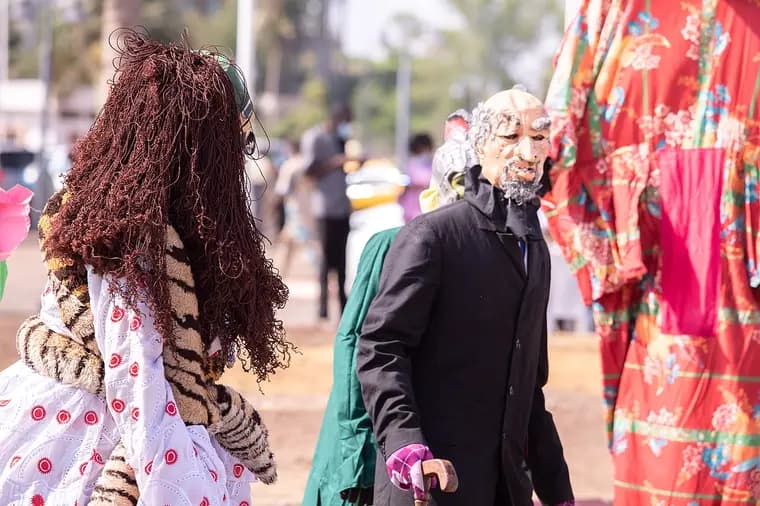
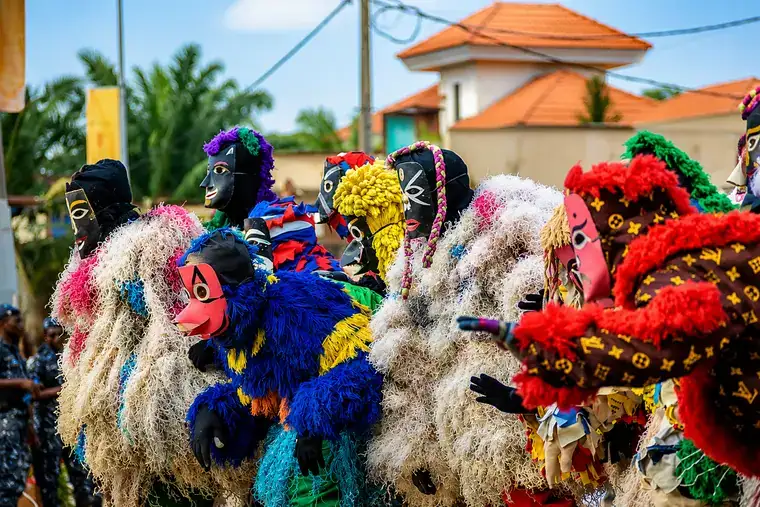
The Bourian is the carnival of the Agouda, a mask dance inherited from Brazil. Its name comes from the Portuguese burrinha, the little she-donkey: in the time of slavery, the captives danced to honor their masters' animals, the ox and the donkey. Turned into a codified street theatre in Ouidah and Porto-Novo, the Bourian parades a whole people of masks. The ox, the central figure, the donkey and the horse, but also the elephant, the giraffe, the rhinoceros, giants three and a half meters tall named Yoyo and Yaya, and above all Mami Wata, the woman with serpents, surrounded by her suitors in white suits. The troupes compete, sing in Portuguese to samba tunes, and traditionally come out in January for the Bonfim festival. It is the Beninese adaptation of the Brazilian bumba-meu-boi, a direct cousin of the carnivals of Bahia.
Christmas
The Kaléta
The Kaléta is the festival of the end-of-year masks. As Christmas nears, masked groups, adults, teenagers and above all children, go from house to house dancing and singing, carried by the drums and the gongs, and receive in return a few coins or sweets that the troupe shares. Brought back from Brazil in the mid-19th century by the freed people, the Kaléta is still danced across southern Benin, and Ouidah devotes to it each year the Kaléta and Agouda Arts Festival. Beneath the costume, the masks embody strong figures, well-known personalities, and sometimes deities such as Mami Wata with her serpent belt.
One Family
The Aglangodji
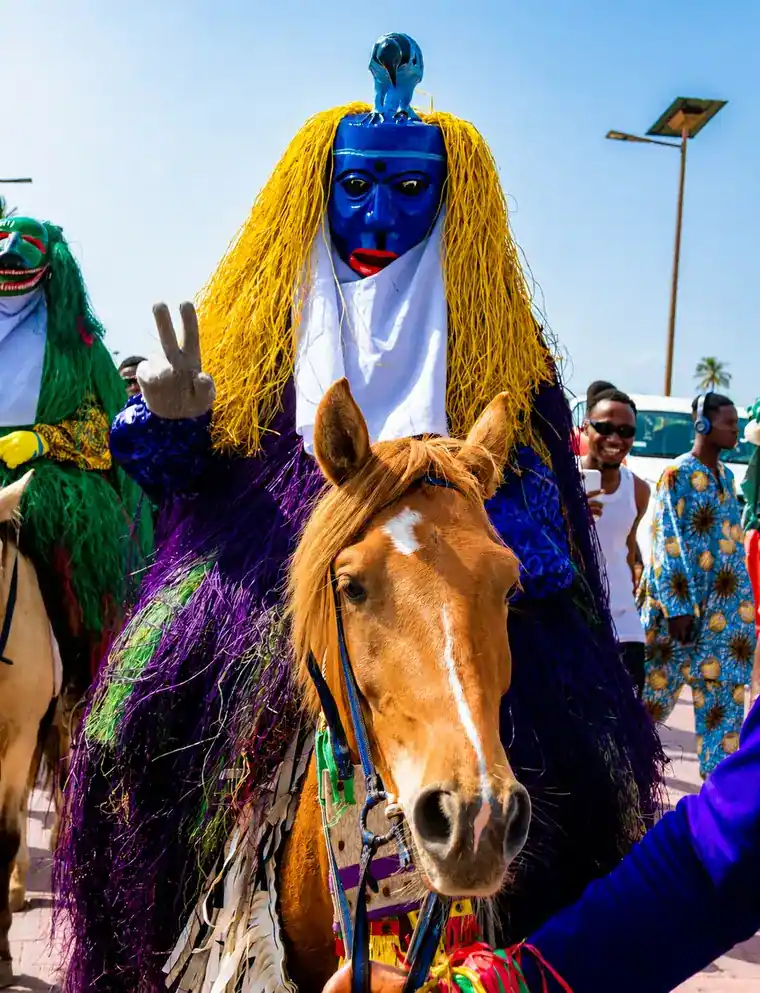
The Aglangodji, on the other hand, comes not from Brazil but from Portugal, and it belongs not to the whole town but to a single family, the da Costa Aguidissou. Its wooden mask was born from a Portuguese model that reached Ouidah in the early 18th century, in the time when the Portuguese held their fort, built in 1721, today the International Museum of the Memory of Slavery. The Aguidissou family house still stands right across the way, on the other side of the paved road. Handed down by the patriarch Roger Aguidissou, the ensemble originally rested on three masks that spell out a whole reading of the family. Agbanbèlayé, the chief, whose Yoruba name recalls that no family holds together without a great figure of reference. Ilé Koléfô, the queen, who honors the role of elders and women in the cohesion of the home. And the Aglangodji, the third, recognizable by its brisk, jerky movement, the very one that gave it its name. These masks come out only once a year, in December, on the 24th and 25th, echoing the Portuguese Christmas, within the Festa de Nata. The festival opens with a gathering of the Aglangodji on horseback on the beach of Djègbadji, continues through a procession in the streets, then a great vigil in the courtyard of the family house, from midnight until dawn.
These masks are not a surface entertainment. They are the way the Agouda kept joy despite exile, and the way, every year, they say again in the open street where they come from. To see them dance, to grasp what each figure tells, is to touch the living link between Ouidah and the other shore of the Atlantic.
The Table
Fechouada, the dish of reunion
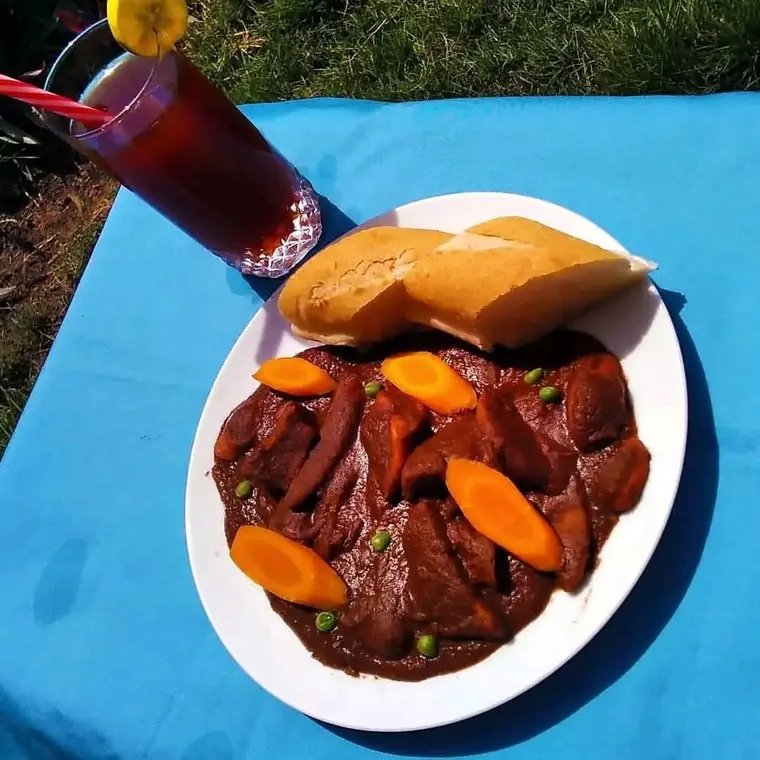
Among the Agouda, people gather around a dish, and that dish tells their whole story. Fechouada, the Beninese adaptation of Brazilian feijoada, was born in the kitchens of the senzala, the slave quarters of Brazil, where the captives simmered beans with what the masters left aside. This dish of little became a dish of celebration. Brought back to Ouidah with the freed people, it married the land: beans, meat, dried shrimp, onion, garlic, tomato, thyme and bay leaf, slowly cooked. At New Year, it is around the fechouada that the whole Agouda family gathers, at the same table, the elders and the young, those of Ouidah and those returned from afar. A dish born of the worst of slavery, become the dish of reunion: there is no more beautiful image of what the Agouda are.
The Agouda year is thus paced by gatherings that hold the community together. In January, the Bonfim pours through the streets. In December, the masks come out. At New Year, people gather around the fechouada. Each of these dates is a way to count one another, to remember and to pass on.
Two Shores
Agouda and Vodun, one same soul
We sometimes picture the Agouda Catholic on one side, Vodun on the other. The reality of Ouidah is deeper. Many Agouda families kept, beneath the faith brought back from Brazil, their loyalty to the deities and the ancestors. In Bahia itself, the deported Africans had gone on honoring the Orisha behind the Catholic saints: what the world called candomblé was born of that loyalty. On returning, the Agouda brought back this dual belonging, not as a contradiction, but as a way to hold together everything they were.
That is why Ouidah, world capital of Vodun, is also an Agouda capital. The two histories do not oppose each other, they answer each other. To understand the Agouda is to understand that deportation did not cut the spiritual thread: it stretched it as far as Brazil, as far as the Antilles, as far as Cuba, and that thread can be tied again.
Ancestral reconnection
Le Retour, ancestral reconnection in Ouidah.
The most intimate protocol of the house, from 4,000 euros. Rare places, guidance over time, led by the elders and communities of Ouidah.
For the Diaspora
Finding this history, today
If you are from Brazil, the Antilles, the Caribbean or the Americas, the Agouda story concerns you directly. It says that return is not a utopia: others did it, they are here, and their descendants welcome you. This is the heart of what the NGO Wa Afriki offers through After Vodundays: not one more tourist circuit, but real access to this memory, accompanied by those who carry it.
Concretely, this means walking through the Brazilian quarter with someone whose family history it is, sharing the table of an Agouda house, and, for those who wish, beginning a more intimate reconnection, guided by the elders and communities of Ouidah. This path is called Le Retour. It is not told on a page, it is lived on the spot, with discretion and seriousness. What the NGO guarantees is the truth of the protocol and recognition by a community of the town. It never promises a laboratory result: here, recognition is customary and spiritual, it cannot be reduced to a test.
This access exists nowhere else in this form. It cannot be reproduced by an agency, because it rests on ten years of groundwork and on the trust of the families. Places are rare by nature, and a significant share of what you commit goes directly to the local stakeholders who make these encounters possible. The price does not pay for a stay, it pays for a door that no one else can open.
The Names
It all starts with a name
For many descendants, it all starts with a name. The Agouda surnames, de Souza, d'Almeida, Paraiso, de Medeiros, Gomez, da Silva, Vieyra, dos Santos, are so many doorways into a genealogy that the Atlantic had blurred. Some of these names are famous in Ouidah, others scattered across the whole region and into the diaspora. To find yours in Agouda history is sometimes the first step of a reconnection.
It is also a question of citizenship and belonging, which Benin takes seriously toward its scattered children. If this dimension speaks to you, our page on Beninese citizenship for Afro-descendants opens that other door.
Questions · Agouda & Memory
What you are wondering.
Who are the Agouda?
The Agouda are the Afro-Brazilian community of Ouidah and the coast of the Gulf of Benin. They are the descendants of Africans deported to Brazil during the slave trade, who returned free in the 19th century to the land of their ancestors, joined by freed people from Bahia. They founded the Brazilian quarter of Ouidah and keep a distinct identity alive there.
Where does the word Agouda come from?
The term Agouda, or Aguda, refers in the region to the Afro-Brazilians who returned from the other side of the Atlantic and, more broadly, to everything tied to this Brazilian heritage: the houses, the cuisine, the festivals, the families. It took hold through the 19th century, as these returning communities put down roots along the coast.
What is the difference between the Agouda and Vodun?
The Agouda are a human community, Vodun is a spiritual tradition. The two meet in Ouidah more than one might think: many Agouda families live a dual belonging, a faith brought back from Brazil and a loyalty to ancestors and deities. Far from clashing, these two heritages tell the same story of faithfulness kept alive despite exile.
What are the Bourian, the Kaléta and the Aglangodji?
They are the great mask traditions of the Agouda. The Bourian is a carnival brought from Brazil, an adaptation of the bumba-meu-boi, in which the ox, the donkey, giants and Mami Wata parade. The Kaléta is the festival of dancing Christmas masks, where children go from house to house. The Aglangodji, of Portuguese origin, belongs to the da Costa Aguidissou family and comes out every year on 24 and 25 December in Ouidah.
How can the diaspora reconnect with the Agouda heritage?
By coming to Ouidah, within an accompaniment designed for reconnection. The NGO Wa Afriki offers immersion stays and, for the most intimate journeys, the protocol called Le Retour, guided by the elders and communities of the town. The first step is simple and without commitment: a message, a conversation, to say where you come from and what you are looking for.
Return is not a dream, it is an address